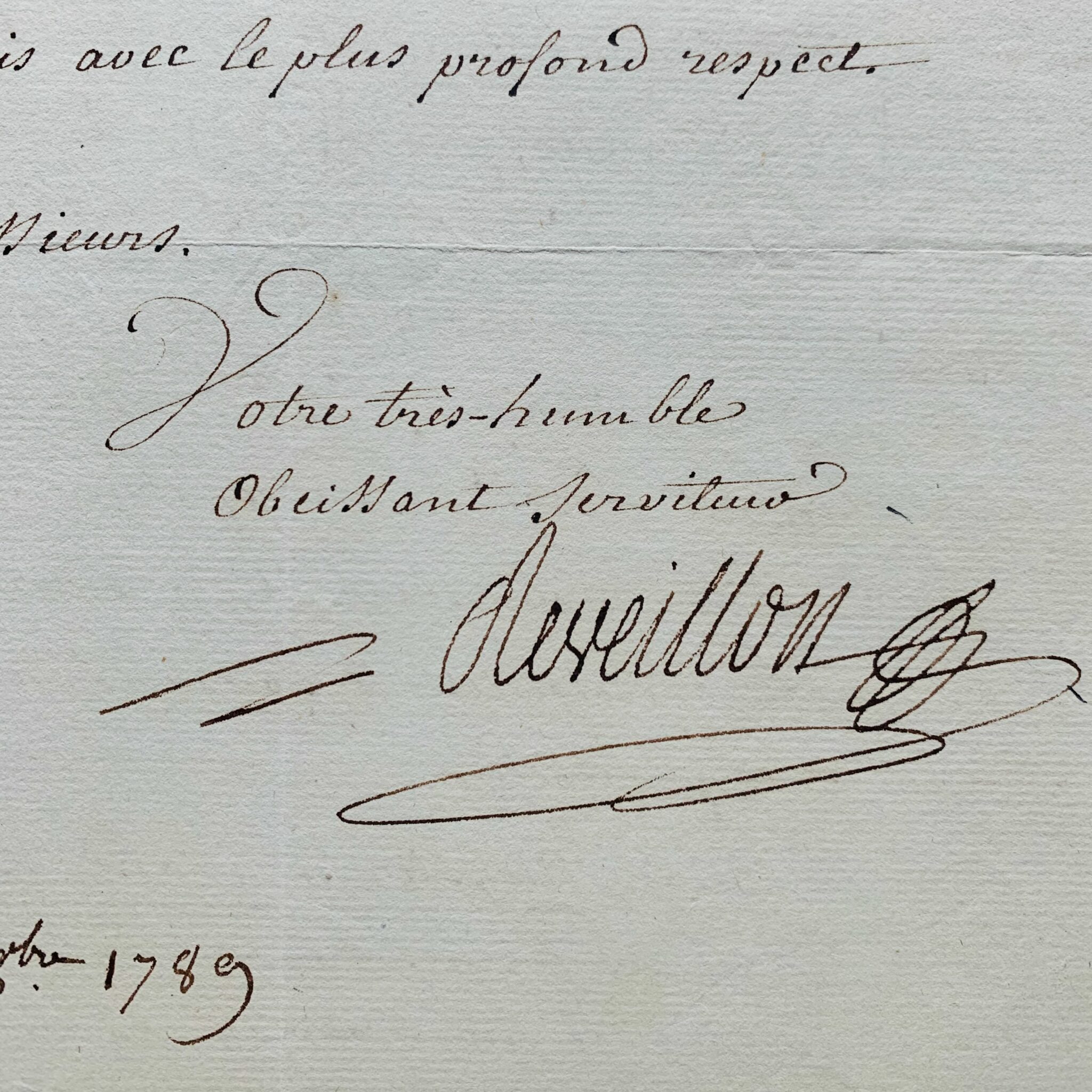
This letter from Jean-Baptiste Réveillon, written in London on October 12, 1789, bears witness to the political and social upheavals that accompanied the first months of the French Revolution. Owner of the royal wallpaper factory, La Folie Titon, located in the Faubourg Saint-Antoine, Réveillon had been forced to leave France after the violent riots of April 28 and 29, 1789, sparked in particular by remarks attributed to him concerning workers' wages.…
Read moreThis letter from Jean-Baptiste Réveillon, written in London on October 12, 1789, bears witness to the political and social upheavals that accompanied the first months of the French Revolution. Owner of the royal wallpaper factory, La Folie Titon, located in the Faubourg Saint-Antoine, Réveillon had been forced to leave France after the violent riots of April 28 and 29, 1789, sparked in particular by remarks attributed to him concerning workers' wages. Now a refugee in London, he responds here to the decree of the Popincourt district of September 20, in which its inhabitants expressed their compassion for his misfortunes and offered to place him and his property under their protection. This letter, which expresses his gratitude and his desire to return to France, thus reveals the attempts at reconciliation surrounding a man who, just a few months earlier, had become one of the first emblematic victims of the Revolution's social tensions.
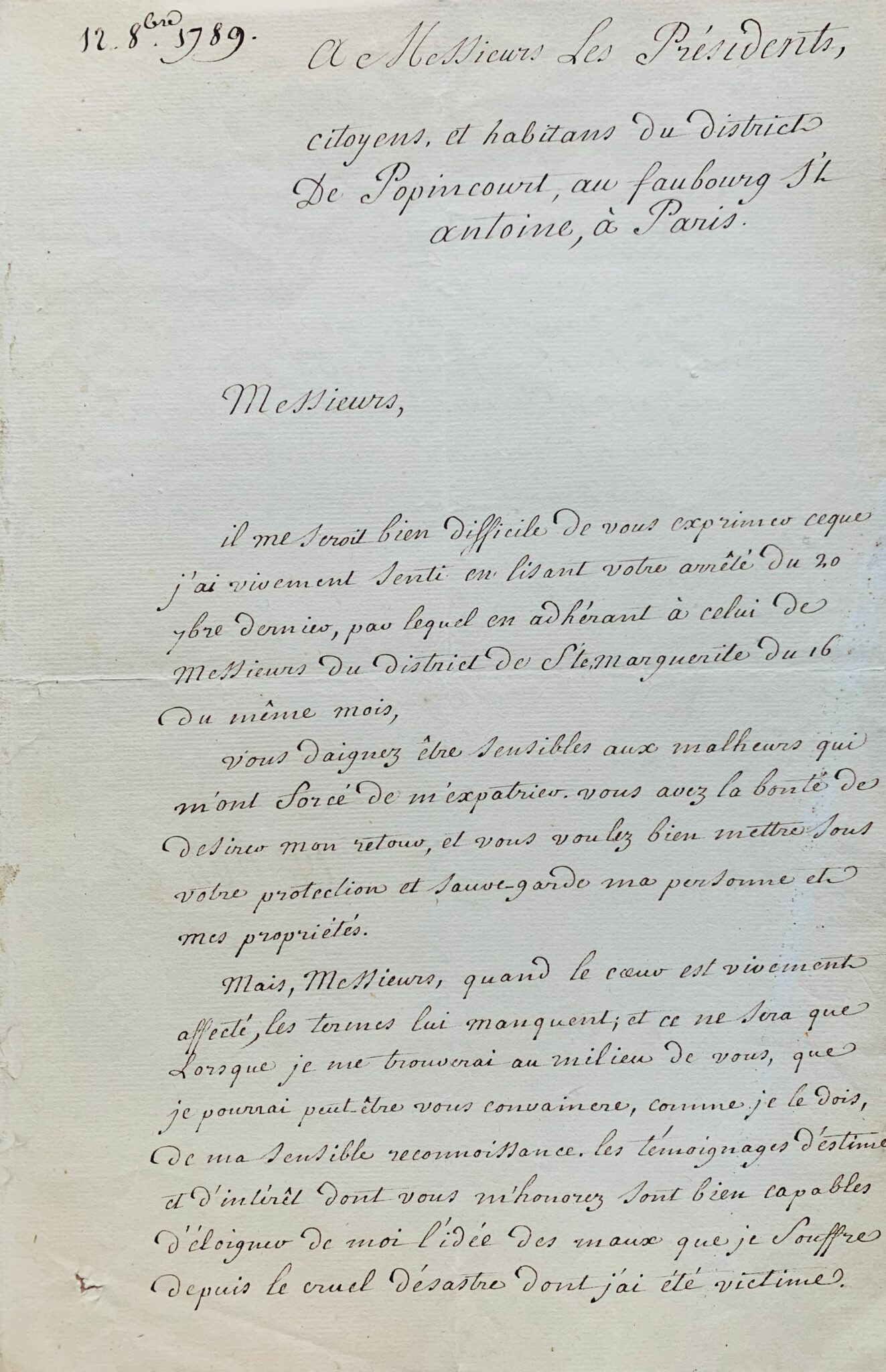
"It would be very difficult for me to express what I deeply felt upon reading your decree of September 20th, by which, adhering to that of the gentlemen of the district of Sainte-Marguerite of the 16th of the same month, you deign to be sensitive to the misfortunes that forced me into exile. You are kind enough to desire my return, and you are willing to place my person and my property under your protection and safeguard.".
But, gentlemen, when the heart is deeply moved, words fail it; and it will only be when I am in your midst that I may perhaps be able to convince you, as I ought, of my heartfelt gratitude. The expressions of esteem and concern with which you honor me are quite capable of dispelling from me the thought of the suffering I have endured since the cruel disaster of which I was a victim.
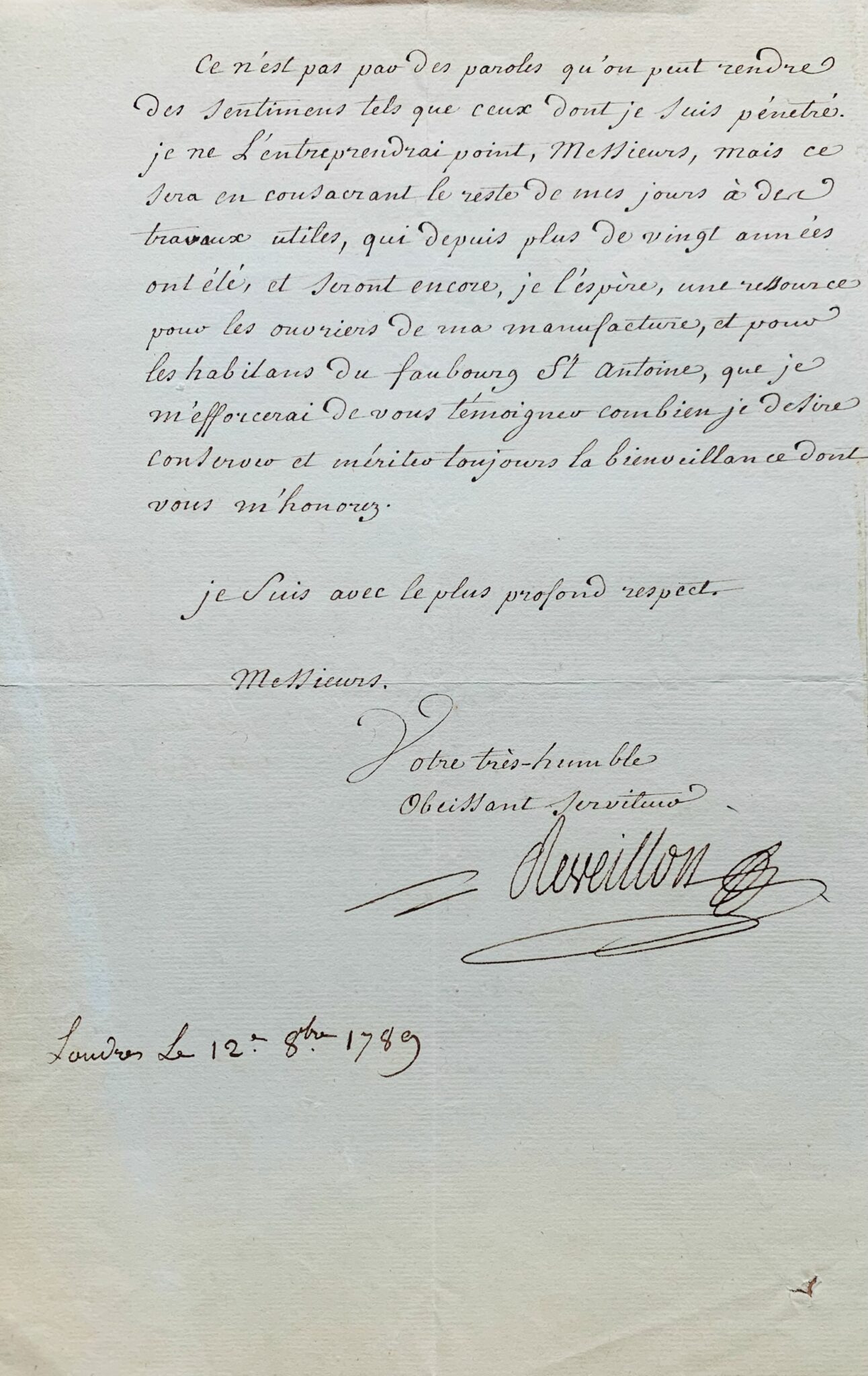
Words cannot express sentiments such as those that fill me. I will not attempt to do so, gentlemen, but by dedicating the rest of my days to useful work, which for more than twenty years has been, and will continue to be, I hope, a resource for the workers in my factory and for the inhabitants of the Faubourg Saint-Antoine, I will strive to show you how much I desire to retain and always deserve the goodwill with which you honor me.
This letter is directly linked to the famous Réveillon affair, one of the most significant episodes of the early French Revolution. On April 27 and 28, 1789, the wallpaper factory of Jean-Baptiste Réveillon, located in the Faubourg Saint-Antoine, was looted and burned following rumors that its owner intended to lower workers' wages; hiseffigy was carried to the Place de Grève and hanged. These riots, which claimed several hundred lives, are now considered a prelude to the storming of the Bastille on July 14, 1789, in which his workers participated.
Reduce