Important and complex scientific letter by Clémence Royer in which she develops a proposal for experiments using the Eiffel Tower to determine the nature of the Earth's core and its impact on the tides.
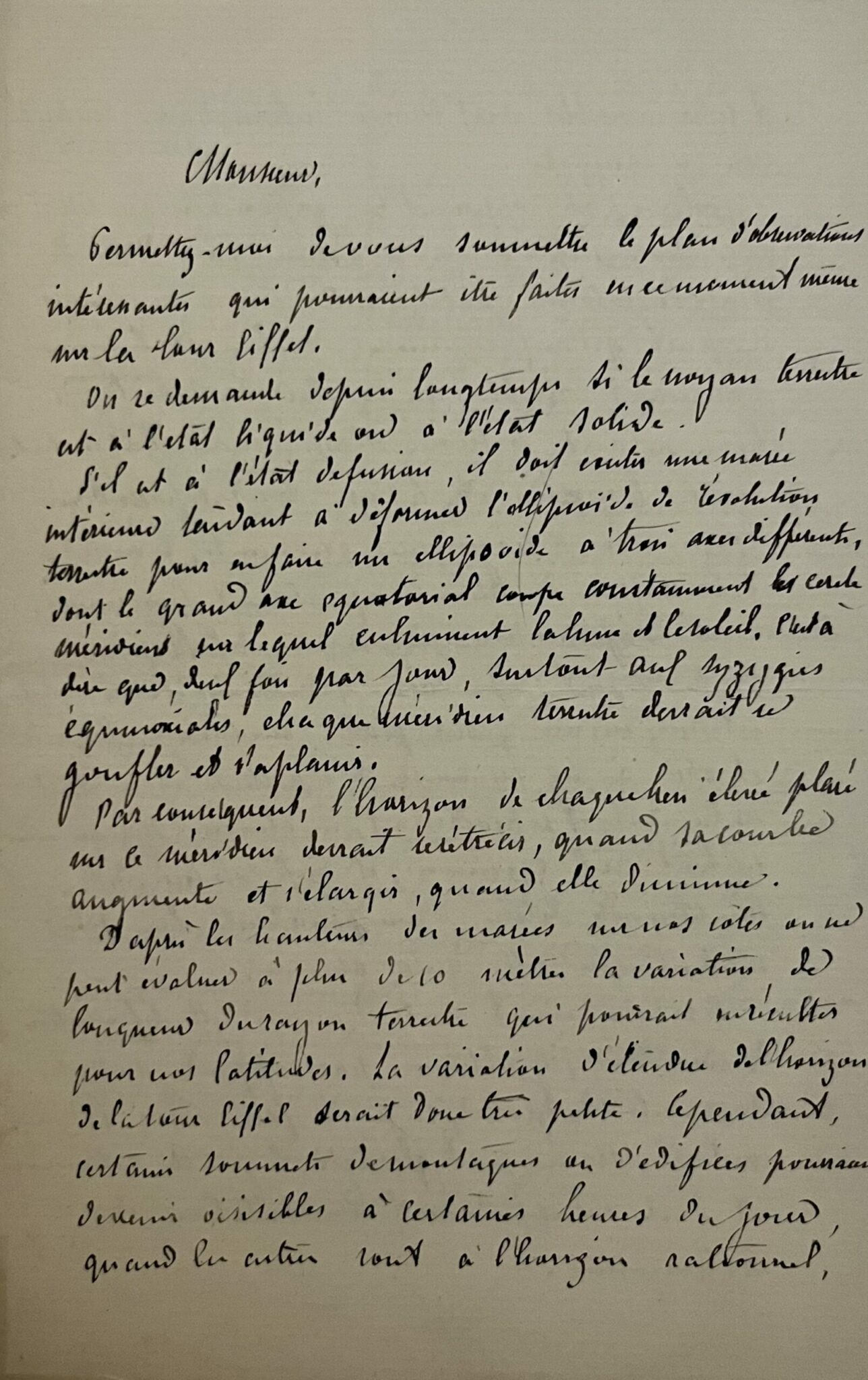
"Sir, allow me to submit to you a plan of interesting observations that could be made right now on the Eiffel Tower. It has long been a subject of debate whether the Earth's core is in a liquid or solid state. If it is in a molten state, there must be an internal tide tending to deform the Earth's ellipsoid of revolution, making it an ellipsoid with three distinct axes, the major equatorial axis of which constantly intersects the meridian circles, on which the moon and the sun culminate. That is to say, twice a day, especially at the equinoctial syzygies, each terrestrial meridian should swell and flatten. Consequently, the horizon of any elevated location on that meridian should narrow when its curve rises and broaden when it falls.".
Based on tidal heights along our coasts, the variation in the Earth's radius that could result at our latitudes cannot exceed 10 meters. The change in the horizon's extent from the Eiffel Tower would therefore be very small. However, some mountain peaks or buildings might become visible at certain times of day when others are on the horizon, and remain invisible at intermediate times, especially around the equinoxes.
Several facts support the supposition that this variation exists. I have been assured that in Marseille, it is a well-known fact among the port's sailors that only at the equinoxes do the Pyrenees become visible at sunset. From Lyon, Mont Blanc is visible, but it is primarily visible in the morning and evening. It is as if, at these same times, the meridian of the Rhône Valley flattens slightly. This periodic deformation of the Earth's ellipsoid can only occur if its solid crust is thin enough to float on the liquid core and submit to its pressures. If this were not the case, earthquakes would occur at each syzygy, but especially at the equinoxes and solstices, with a periodicity far more pronounced than that which is observed.
If this movement exists, as this deformation of the meridians, symmetrical with respect to the center of gravity of the globe, cannot vary the vertical, it cannot change the astronomical zenith and must escape the observations of astronomers.
The observations to be made to confirm them would be of two kinds.
1° direct observations with a telescope, renewed hourly, on the greater or lesser visibility of certain fixed landmarks, chosen at the four cardinal points of the horizon, such as towers or steeples, buildings, trees or mountain peaks, which would be seen at varying parts of their height.
2° photographic observations, consisting of taking, at the same times, circular views of the horizon, which would then be compared under a microscope.
Variations in atmospheric refraction would complicate the problem, but aside from the fact that they can be taken into account to some extent, there is no reason why the value of this refraction should increase at syzygies or equinoxes and decrease at intermediate times. It could therefore not conceal the existence of the variation to be observed, provided that the observations were sufficiently numerous and made at regular intervals. Having no means of making these observations myself, I believe it best, Sir, to submit the plan to you.
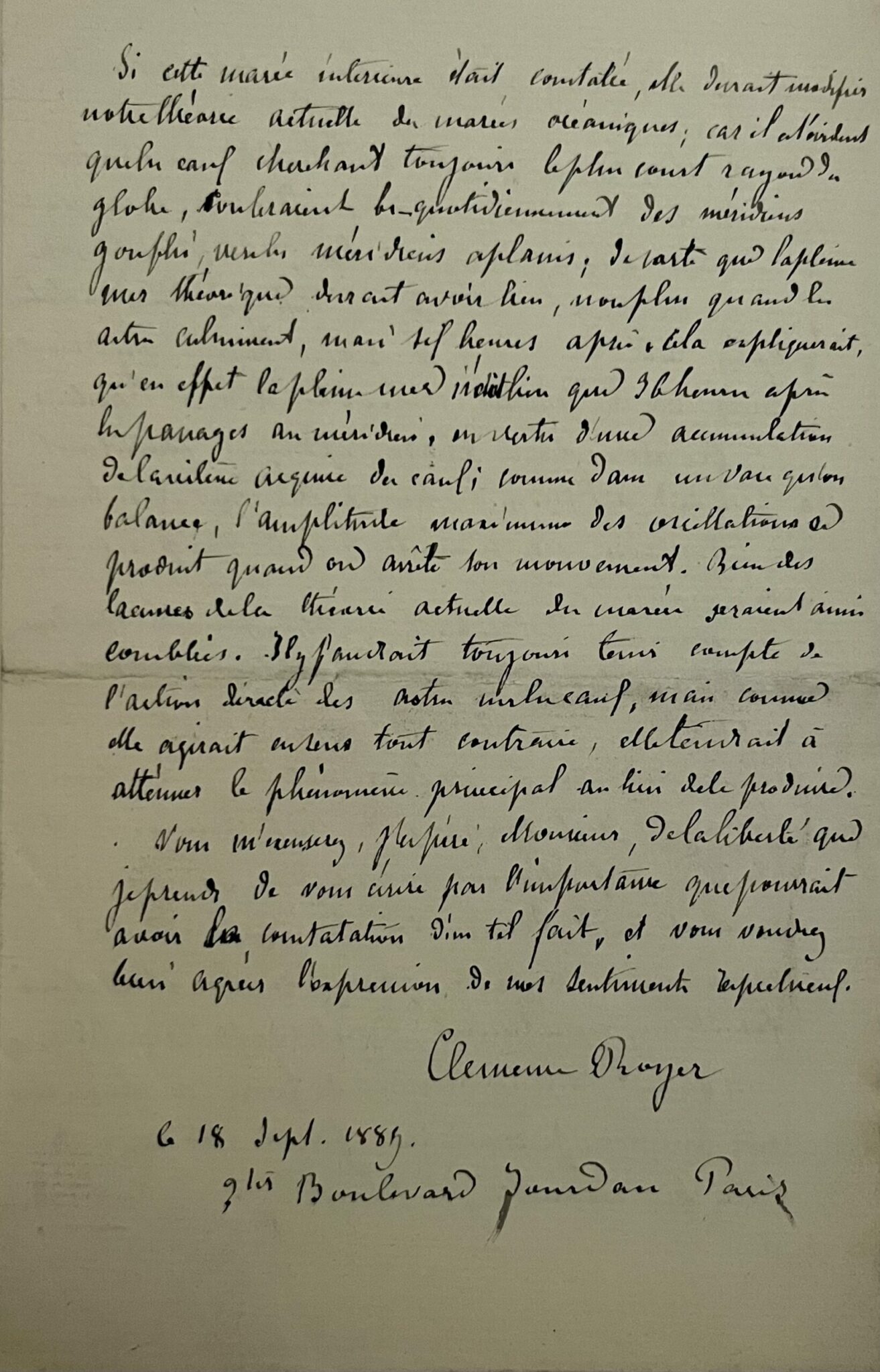
If this internal tide were observed, it should modify our current theory of ocean tides; for it would mean that the waters, always seeking the shortest path, the radius of the globe, would flow twice daily from the bulging meridians towards the flattened meridians; so that the theoretical high tide should occur not when the stars culminate, but six hours later. This would explain why high tide does not occur until 36 hours after meridian transits, due to an accumulation of the acquired velocity of the water; like a vase being rocked, the maximum amplitude of the oscillations occurs when its movement is stopped. Many gaps in the current theory of tides would thus be filled. It would still be necessary to take into account the direct action of celestial bodies on the water, but since this action would act in the opposite direction, it would tend to attenuate the main phenomenon instead of producing it.
I hope you will excuse me, Sir, for taking the liberty of writing to you, given the potential importance of establishing such a fact, and I hope you will accept the expression of my respectful sentiments. Clemence Royer.
Reduce